
What makes a presentation feel credible?
The invisible factors that shape how people perceive your ideas.

You can have the best data in the market, a brilliant idea, and a solution that solves a major problem. But if your presentation fails to communicate that value, you might not convince anyone. And I’m not just talking about beautiful slides. 👀 A presentation involves a lot more than most people realize.
The narrative needs to guide the audience through your reasoning. The text on the slides needs to be clear, concise, and make sense. The design needs to make information easier to understand. The way you carry yourself matters, too. Your tone of voice, your pace, your pauses. Even what you wear communicates something.
It’s not about following an etiquette manual or pretending to be someone else. It’s about making sure the way you present yourself aligns with the message you want to convey.
And all of this needs to be carefully thought through because, on the other side of the screen, we have humans constantly trying to save their brains some energy.
Think of it like baking a cake 🎂: having great ingredients is essential, of course. But one little mistake can keep the cake from rising. The same goes for a great presentation. It’s the result of several factors working together. And when one of them fails, the whole thing can lose its impact.
At Pappum, we have a presentation development process that works really well. Here are some of the key points.
1. Content 💬: What do you need to communicate?
There’s one very important question you need to answer before doing anything else: what do you need to communicate? It sounds obvious, but this is where many presentations start going wrong.
We often work with experienced professionals who have tons of knowledge and years’ worth of previous presentations. The result? A Frankenstein’s monster of old decks, all stitched together in an attempt to fit in every piece of information that might be important.
But in practice, if everything is important, nothing is. You need to define what your audience actually needs to know to reach a clear conclusion.
Think about a sales presentation. The goal isn’t to tell the audience absolutely everything about the company: who the founders are, its history, how it grew... It’s to show why that company is worth choosing.
So, what really needs to go into the presentation? What could be included in a separate document instead?
2. Storytelling 🎬: A presentation needs to take you somewhere.
Now that you know what you need to say, there’s another question: in what order?
You know those movies that start with scenes all jumbled up, leaving you completely confused? A presentation without a clear narrative can feel the same way.
When the slides aren’t connected, people have to do the work of organizing the information and following the logic themselves. And, more often than not, they won’t. They’ll start thinking about something else and stop paying attention to you.
Content provides the information. Storytelling connects the dots and shows why they matter.
3. Design 🎨: The way you show something changes how people understand it.
Adding a beautiful photo, choosing sophisticated colors... All of that can improve the look of your slides, but it doesn’t guarantee they’ll communicate more effectively. Design needs to help your audience understand the information.
Imagine you need to present a 35% increase in revenue. Which slide is clearer to you: slide 1 or slide 2?
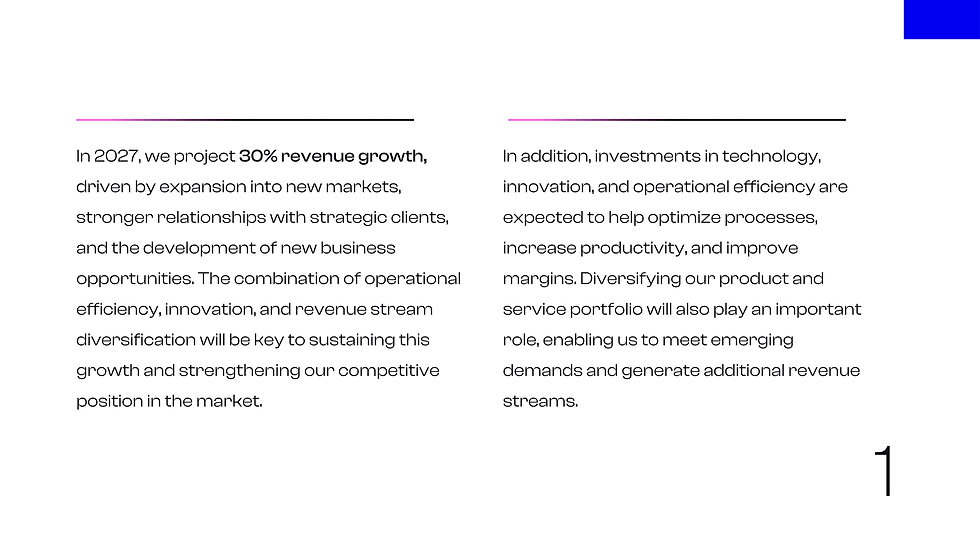
See the difference? Most of the supporting details belong in what you say, not on the screen.
4. Visual identity 👁️: Your presentation communicates who you are.
Imagine a brand that positions itself as premium but presents its ideas using disorganized slides. Something doesn’t quite add up.
That’s why visual hierarchy, typography, colors, images, and charts are more than decorative elements. They help people understand the information. All these elements need to work together and make sense for your brand, your audience, and the context of the presentation.
A corporate presentation, an investor pitch, and a sales proposal all have different goals and visual needs.
5. Communication 🗣 : Slides don’t present themselves. 🗣️
You can have perfect content, a well-crafted narrative, and a killer design. But someone still needs to bring it all to life: the person presenting.
Your voice, pace, pauses, posture, clothing, eye contact... It all communicates something and influences how your message is received.
Think about someone who reads every word on the slides while speaking. The audience has to choose between following the text on the screen and listening to the explanation. And in that competition, part of the message gets lost.
Now imagine the slides show the key points while the presenter develops the ideas in their own words, adding context, examples, and arguments. The experience changes. They come across as much more confident and knowledgeable.
The deck stops being a giant script and starts working as a tool to support the conversation. The focus should always be on the person presenting.
The two need to work together, not compete for attention.
6. Preparation ✅: Even a great presentation can go wrong (speaking from experience 🫠).
So one of the most important part is the preparation. Does the file open properly? Do the videos work? Are the colors and text legible on the screen they’ll be projected onto? Does the presentation flow when you go through the slides out loud, from beginning to end?
These questions seem minor until something goes wrong.
And, of course, unexpected things happen. Even the best preparation can’t control everything. We’ve made mistakes and learned a lot at Pappum. Today, we know that being ready for the unexpected is just as important as having a great PowerPoint. We always have a Plan B and, preferably, a Plan C.
So, what makes a presentation feel credible, in my opinion? It’s when every choice has a purpose and everything works in the same direction.
You wouldn’t present just anything, right? So why present it just any old way? Your idea deserves a presentation that does it justice!
At Pappum, we know a great presentation goes far beyond beautiful slides. We bring together content, storytelling, and design to turn complex information into clear presentations that reinforce the value of your ideas.
Have an important idea to present? Let’s talk. 🚀


Comments